04Tennoji & Shinsekai
Tennoji and Abeno: How Osaka’s South Side Fits Together
天王寺・阿倍野駅Tennoji or Osaka-Abenobashi
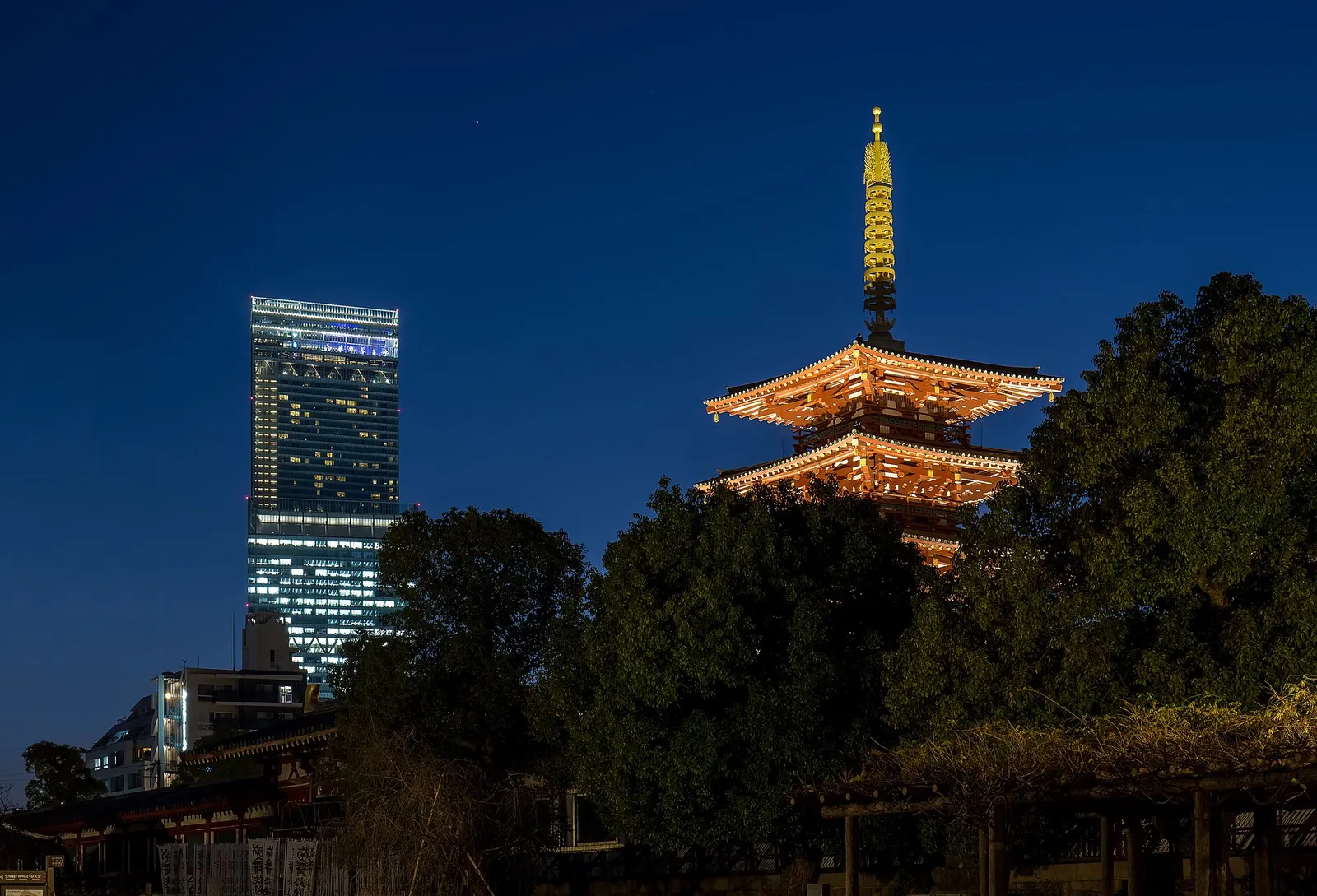
Photo: Laitche, CC BY-SA 4.0
Stand on the footbridge over the Kintetsumae crossing at about six in the evening and most of south Osaka’s business passes under your feet. JR trains slide out of the station on one side, the Kintetsu terminal swallows commuters on the other, and down in the middle of the road a tram waits at its platform as if the last hundred years had not happened. Behind all of it a glass tower goes up 300 metres and keeps its lights on until late.
This is Tennoji (天王寺) and Abeno (阿倍野), and most visitors only meet it from the inside of a train. Kintetsu, which built the tower, counts seven rail and subway lines meeting here. People change at Tennoji for Nara, for the airport, for Wakayama, and never come up for air.
That is a mistake worth about a day. Within a 20-minute walk of the footbridge you have the best view in the city, a department store the size of a small town, a temple founded in 593, a hill of smaller temples with stone slopes between them, a zoo, an old amusement district under a steel tower, and the start of a tram line that will take you to one of the oldest shrines in the country for ¥240. The trick is knowing how the pieces fit, and which ones deserve your time.
Contents目次
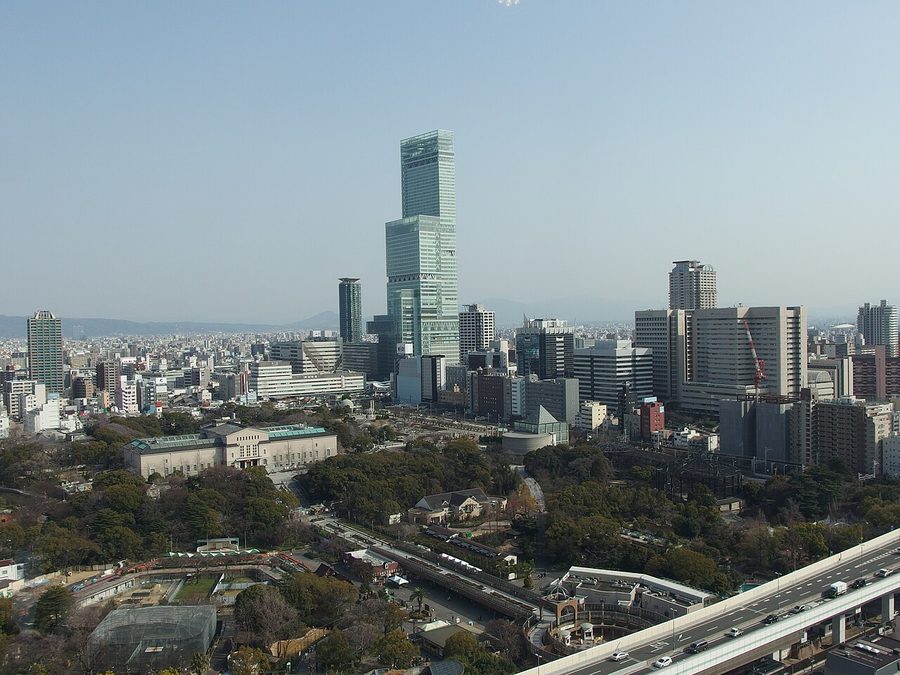
Think of Tennoji as a crossroads on a ridge. The Uemachi plateau (上町台地), the long low spine of high ground that runs south from Osaka Castle, passes right through here, and everything old in the area sits on it or just off it. Shitennoji (四天王寺), the temple that gave the district its name, is a 12-minute walk north of the station. North-west of the temple the plateau’s edge is lined with smaller temples and the stone slopes that drop down towards the flat city.
The station itself is a knot of four operators. Cross the road south from the JR station and you change wards: JR Tennoji and its shopping building sit in Tennoji ward, while Abeno Harukas, across the street, has an Abeno ward address.
How the south side fits together
Around that knot the south side falls into five pieces. West, across Tennoji Park (天王寺公園), is Shinsekai (新世界), the 1912 pleasure district under Tsutenkaku (通天閣). North is the temple, then the temple town.
North-east, three stops up the JR Osaka Loop Line, is Tsuruhashi (鶴橋), Osaka’s market for yakiniku and Korean groceries. South, the Hankai tram runs down Abeno-suji to Sumiyoshi Taisha (住吉大社). And in the middle is the station district itself: Harukas, the malls and the bars behind the station.
The stations, and which gate to use
The names confuse people because the same place has three of them. Here is what you are dealing with, and the gate each operator points you to for Harukas:
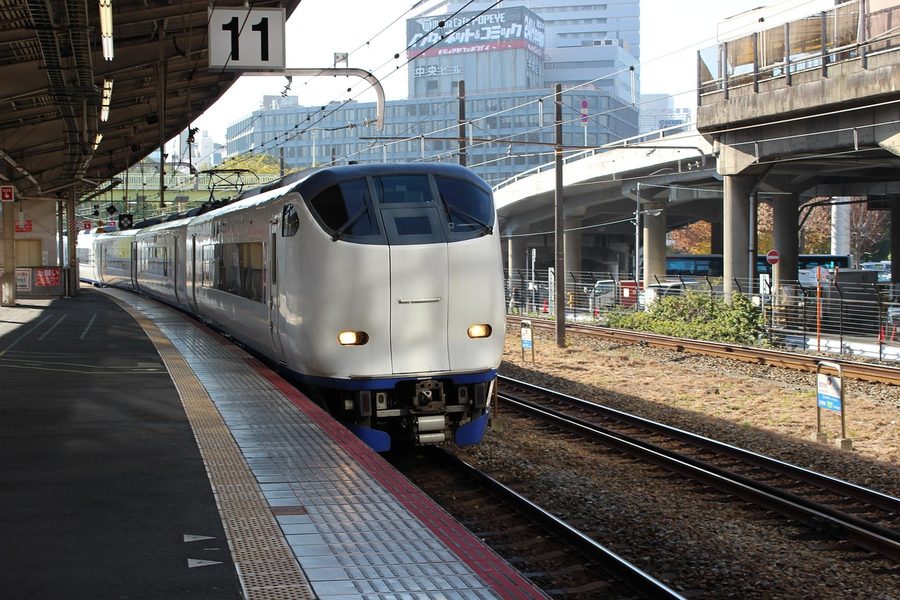
- Tennoji Station (JR West): Osaka Loop Line, Hanwa Line and Yamatoji Line, central gate. The Haruka airport express stops here; Kintetsu puts the ride from Kansai Airport at around 30 minutes.
- Tennoji Station (Osaka Metro): Midosuji Line, west gate; Tanimachi Line, south gate. Namba is three stops north on the Midosuji Line, Umeda seven.
- Osaka-Abenobashi Station (Kintetsu): Minami Osaka Line, west gate, directly under Harukas. Trains run south-east towards Asuka and Yoshino.
- Tennoji-ekimae (Hankai Tramway): Uemachi Line, in the middle of Abeno-suji.
Is Tennoji a good base?
I think it is one of the best in the city for a first trip, for the trains alone. You get the airport express, two subway lines to Namba and Umeda, Kintetsu for Nara’s southern sights, and JR for Nara city and Wakayama, all within a five-minute walk of your lobby. Evenings are quieter than Namba, which some people call a flaw.
The one thing to watch is a hotel marketed as “near Shinsekai” or “Shin-Imamiya”. The blocks south of Shin-Imamiya Station are Kamagasaki, for decades the city’s day-labour district, now changing fast as lodging houses turn into tourist hotels. It is not dangerous, but it is not Abeno either, so look at the map before you book.
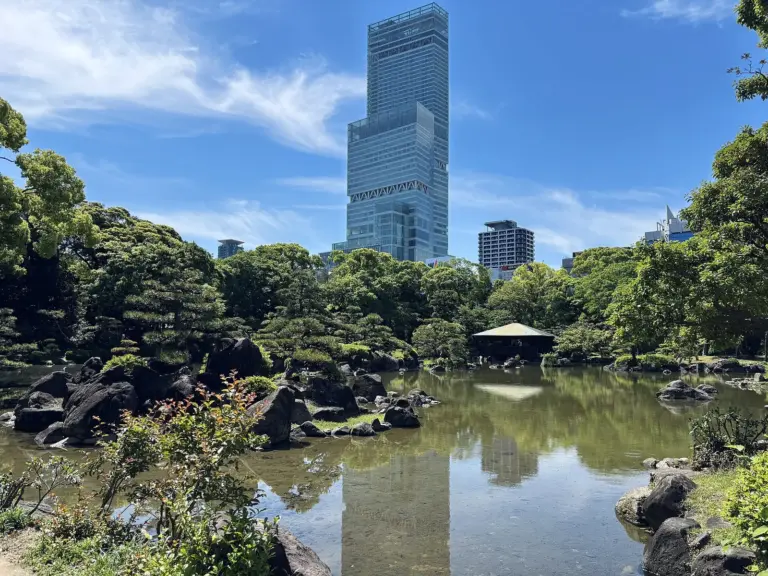
Abeno Harukas
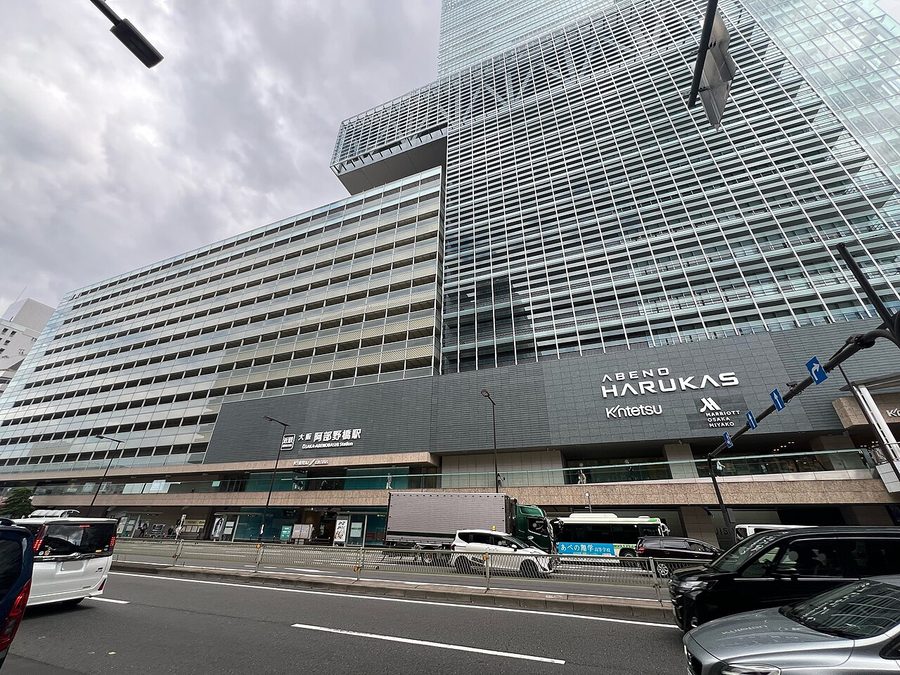
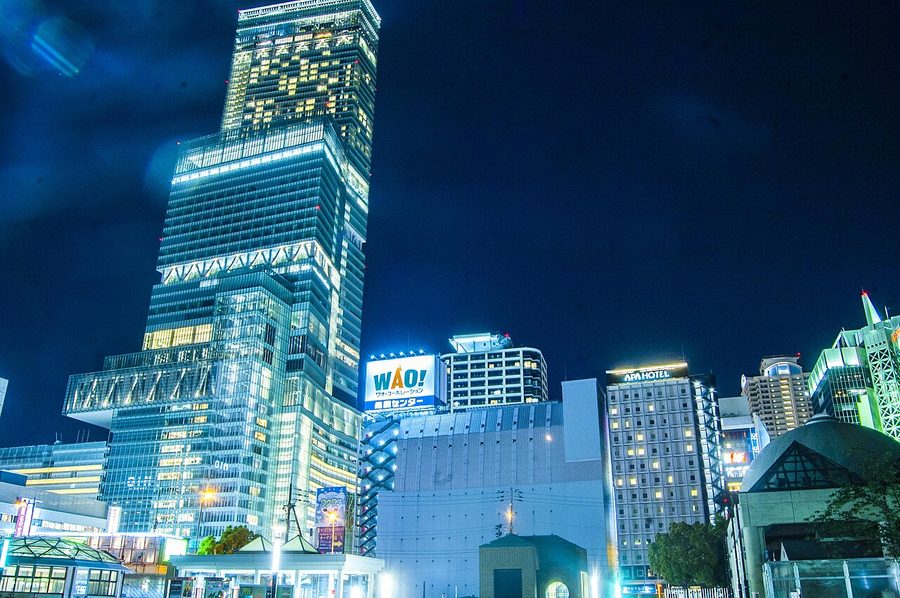
Abeno Harukas (あべのハルカス) is what happens when a railway company rebuilds its terminal and keeps going up. Kintetsu began knocking down the western block of its old Abenobashi department store in March 2009, topped the steel frame out at 300 metres in August 2012 and opened the whole building on 7 March 2014. For nine years it was the tallest building in Japan, until a Tokyo tower passed it in 2023. Osaka has not quite forgiven Tokyo.
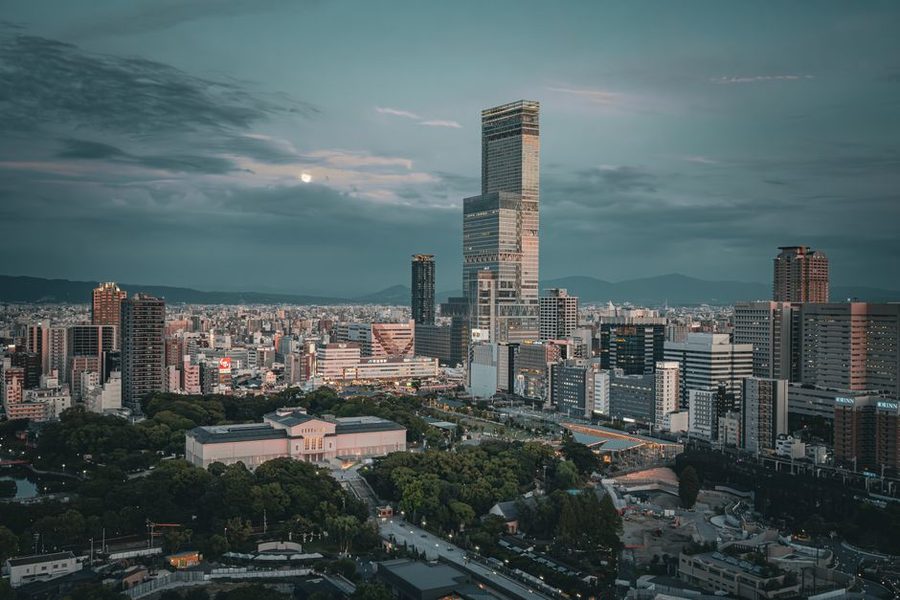
The name comes from an old Japanese verb, harukasu, to clear up or brighten, which the owners picked to match the view. The stack goes like this: the department store from the second basement to the 14th floor, the art museum on 16, offices on 17 to 36, the Osaka Marriott Miyako Hotel across most of 19 to 57, and the observatory, Harukas 300 (ハルカス300), on 58 to 60.
Harukas 300, the observatory
You buy tickets on the 16th floor. Take the Harukas shuttle lift up to 16, queue at the counter, and a second lift takes you from there to the 60th floor in about 50 seconds. The way the floors are arranged is the clever part: you arrive at the top and walk down.
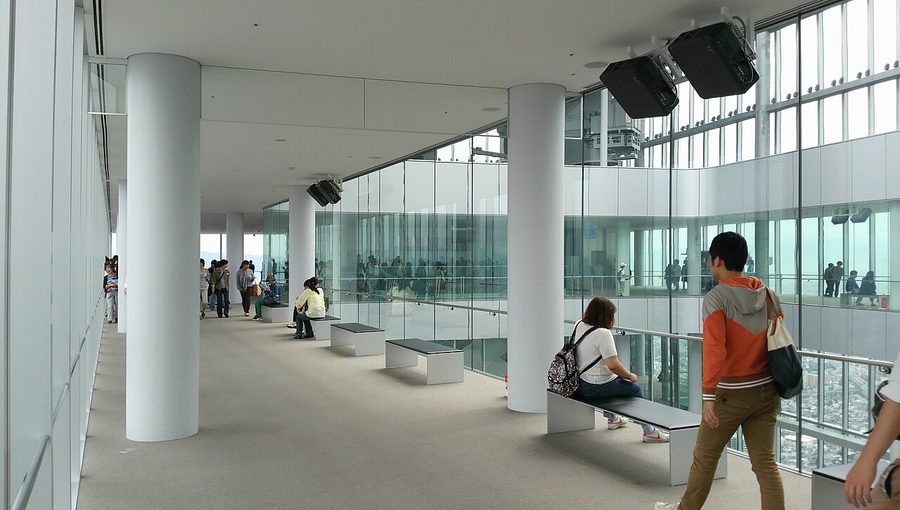
The 60th floor is a glass-walled corridor that circles the whole building, floor to ceiling, with the Osaka plain on every side. On a clear day you can pick out the Rokko mountains behind Kobe, Akashi-Kaikyo Bridge and Awaji Island to the west, the Ikoma range to the east and the planes landing at Kansai Airport to the south-west. Look down north-west and Tsutenkaku looks like a toy.
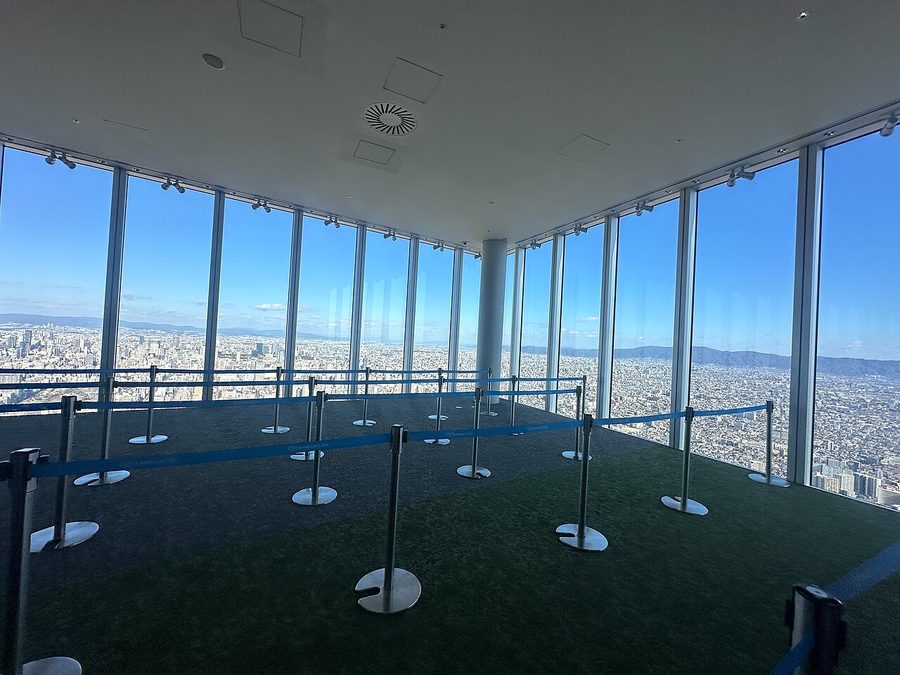
Walk down a floor for the shop on 59, then down again to 58, which is the part I like best. The 58th floor is an open-air courtyard with a wooden deck, open to the sky inside the building’s three-floor atrium, so you get wind and a view at once. A café-bar, Sky Garden 300, sits indoors beside it, serving drinks 9:30–21:30 and food from 10:30 to 21:00.
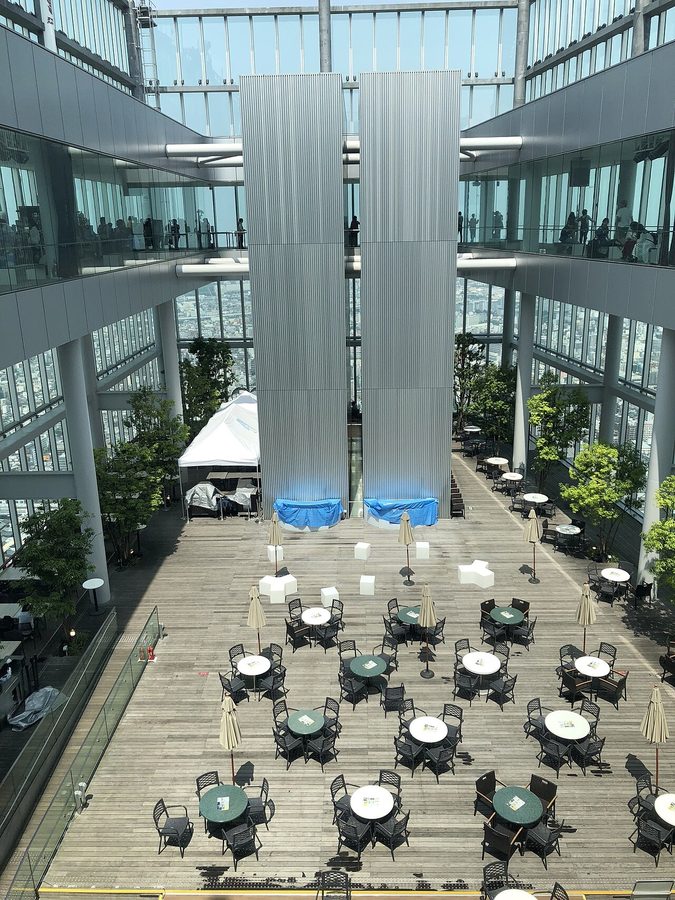
One small game for night visits. The observatory’s own guide promises a “phantom Tsutenkaku” that appears only after dark, in a patch of glass a metre or two square at the north-east corner of the 60th floor. Finding it is the game.
Prices and hours, from the observatory’s Japanese ticket page as of November 2026:
| Ticket | Adult (15 and over, from high school) | Child (6 to 14) |
|---|---|---|
| Same-day, at the 16F counter or online | ¥2,200 | ¥900 |
| Online advance, bought by the day before | ¥1,980 | ¥810 |
| Under 6 | Free | |
The observatory is open every day, 9:00–22:00, with last entry at 21:30, and same-day tickets go on sale ten minutes before opening. There is no re-entry, and on busy days the counter can hand out numbered slips just to buy a ticket. The online advance ticket saves you ¥220 and the counter queue, which on a weekend afternoon is the better saving.
Is it worth it? Yes, on a clear day, and I would rather pay ¥2,200 here once than climb three cheaper towers. The test is the weather. If the plain is grey to the horizon, go to the free garden on 16 instead, look up at the tower, and spend the money on dinner.
Two dated extras, as of November 2026. On 1 January 2027 the observatory opens early for the first sunrise of the year, with plans on sale from 10:00 on 1 December 2026 on its official site. Its winter kotatsu plan, heated low tables with oden, shabu-shabu or sukiyaki, runs until 28 March 2027 and is booked through its own site.
Edge the Harukas and the heliport
For ¥3,000 more, Edge the Harukas puts you outside. You are clipped by harness to a rail and walk a deck about 60 centimetres wide and 20 metres long along the top edge of the building, leaning out over the street 300 metres below. The whole thing takes about an hour, of which about 15 minutes are on the edge, with up to seven people per session and a staff photo included.
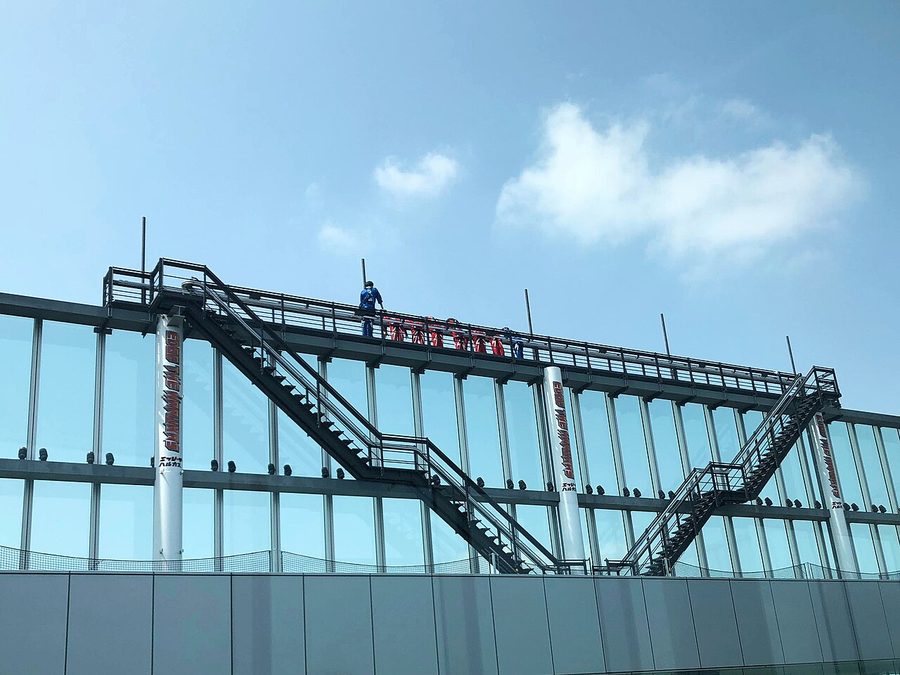
You must be between 145 and 200 centimetres tall, sober and not pregnant, and children of primary age need an adult with them. Book online; same-day places are sold at the 60th-floor counter only when a session starting within two hours still has room. It is seasonal, and the observatory announces a winter break from 1 December 2026, so if you are visiting in winter, plan for spring.
The cheaper thrill is the heliport tour, ¥1,500, sold at the 60th-floor information counter, which takes you up to the helicopter pad on the roof for an unglazed 360-degree view. Both need an observatory ticket on top.
Abeno Harukas Art Museum
On the 16th floor, next to the observatory counter, the Abeno Harukas Art Museum (あべのハルカス美術館) runs exhibitions from Japanese art to Western painting rather than showing a permanent collection. As of November 2026 it is showing Andrew Wyeth until 6 December 2026, then closes to change over before a Lucie Rie ceramics exhibition from 26 December 2026 to 7 March 2027.
Hours during the Wyeth show are 10:00–20:00 from Tuesday to Friday and 10:00–18:00 on Mondays, weekends and holidays, with adult tickets at ¥2,200. Prices and hours change with each exhibition, so check before you go, and never turn up in the gap between shows. Until 6 December 2026 the observatory sells a combined ticket with the museum for ¥3,900, and during the Wyeth show a Tsutenkaku ticket stub knocks ¥100 off the museum, a small Osaka joke about two towers.
The department store
Abeno Harukas Kintetsu Main Store fills the tower from the second basement to the 14th floor and spills into a second building, the Wing, next door. With about 100,000 square metres of selling floor, it is less a shop than a district. The whole store opens 10:00–20:00.
Three parts matter to a visitor. The basement food halls, Abeno Food City, carry Western and Japanese sweets and bread on B1 and fresh food, groceries and deli counters on B2, and if you want to answer the eternal question of what to bring home from Osaka, this is where to stand. On B2, Abeno Ichiba Shokudo is a run of counter restaurants open 10:00–22:00. And floors 12 to 14 of the tower are Abeno Harukas Dining, which the store calls one of the largest restaurant floors in Japan, open 11:00–23:00.
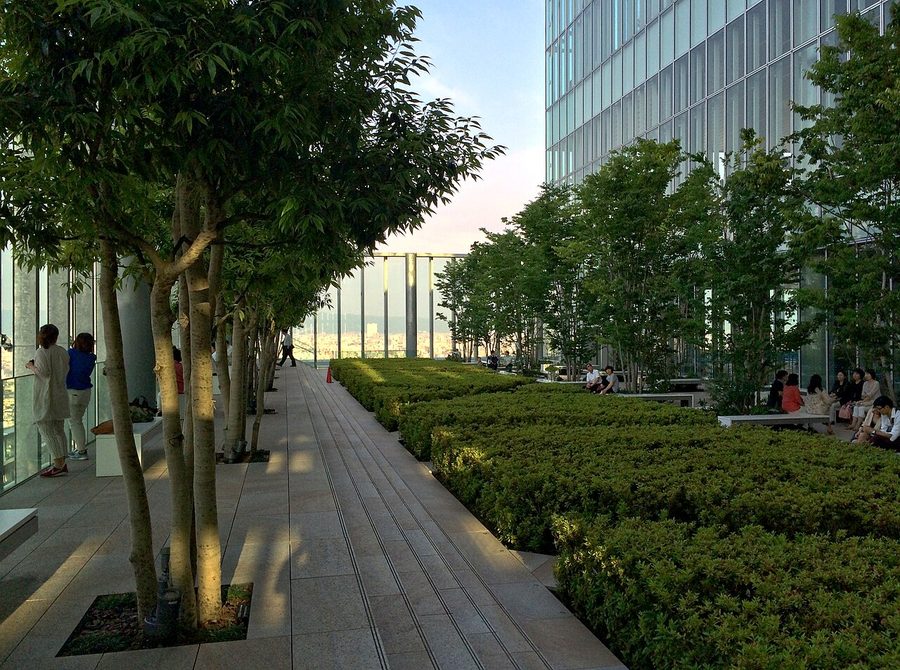
The tower also has a roof you can reach without a ticket. The Wing building’s rooftop, Harukas Wing Garden, has a small rented vegetable plot and a view straight up the tower’s flank, and the observatory’s own guide recommends it as the spot for looking up.
Shopping and eating around the station
Abeno and Tennoji have four big malls within five minutes of each other, which is three more than most visitors need.
Tennoji MIO
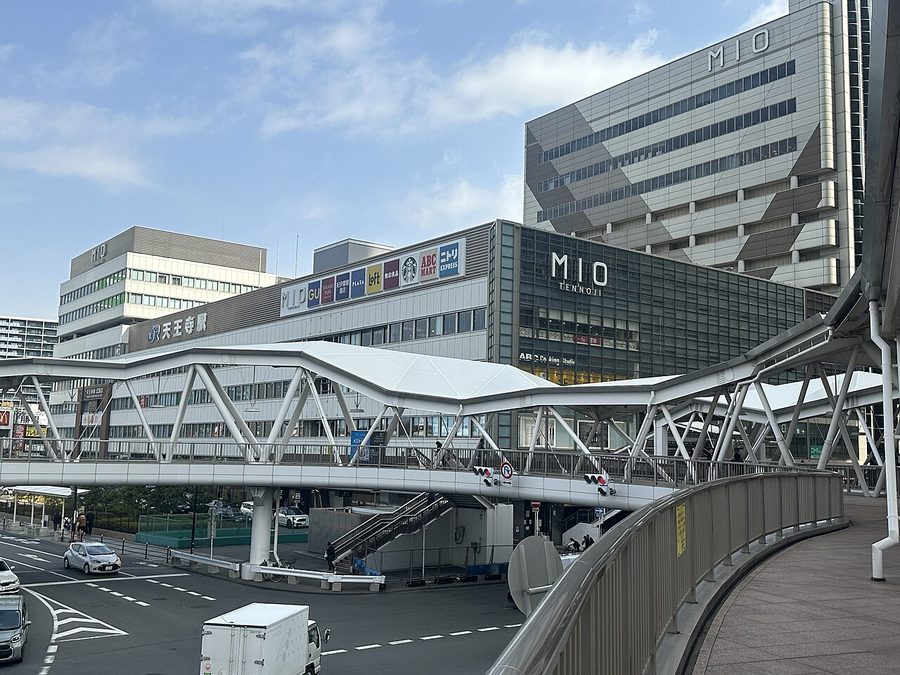
Tennoji MIO (天王寺ミオ) is JR West’s shopping building, and it comes in two parts. The Main Building rises over the JR station, with fashion, cosmetics and homeware on 1 to 7, outdoor goods and shoes on 8, books on 9, and restaurants and cafés on 10 and 11. The Plaza Building, beside it, has a supermarket and food floor in the basement and more restaurants on its mezzanine and fourth floor.
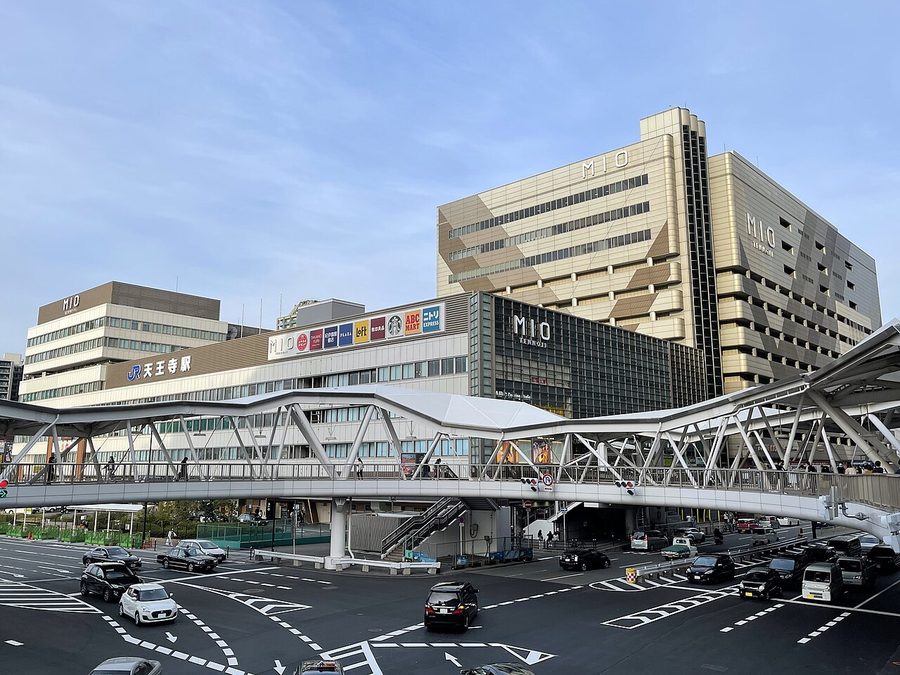
MIO’s hours as of November 2026: shopping floors 10:30–20:30 in both buildings; restaurants 11:00–22:00 on the Main Building’s 10th floor and 11:00–23:00 on its 11th; the Plaza’s restaurant floor 11:00–23:00; the Plaza’s mezzanine restaurant floor, Mio Ekitchen, 10:00–22:00; and the Plaza basement food floor from 9:00 to 21:00, which makes it one of the earliest places in the area to buy breakfast. MIO closes on 31 December and 1 January, plus one day in February.
Among the restaurants, look for Amato Maeda, a kanmi café (a tearoom for Japanese sweets), and Yukari for okonomiyaki, the savoury pancake Osaka argues about. MIO is the practical mall: you go there because you are changing trains and need a book, a charger or a sandwich.
Abeno Q’s Mall and Hoop
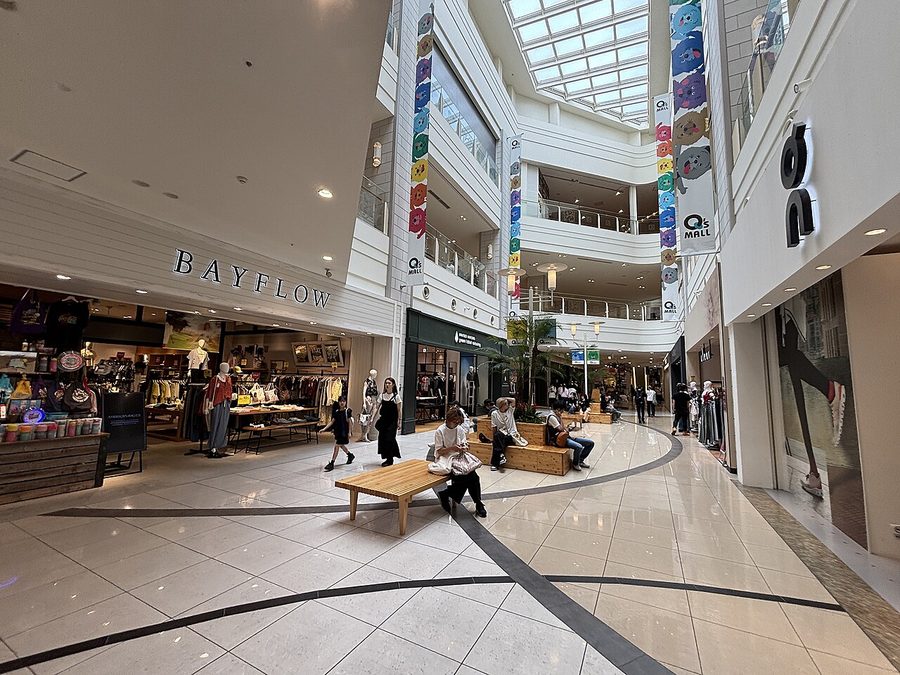
Abeno Q’s Mall, a few minutes’ walk south along the west side of Abeno-suji, is the big low mall that the whole neighbourhood actually shops in: about 215 shops over five levels, from a basement food park up to a fourth-floor restaurant street. On that top floor you will find Chibo for okonomiyaki and Kushiya Monogatari, a chain where you fry your own kushikatsu (breaded, deep-fried skewers) at the table, which is either the best or worst idea for a group of children.
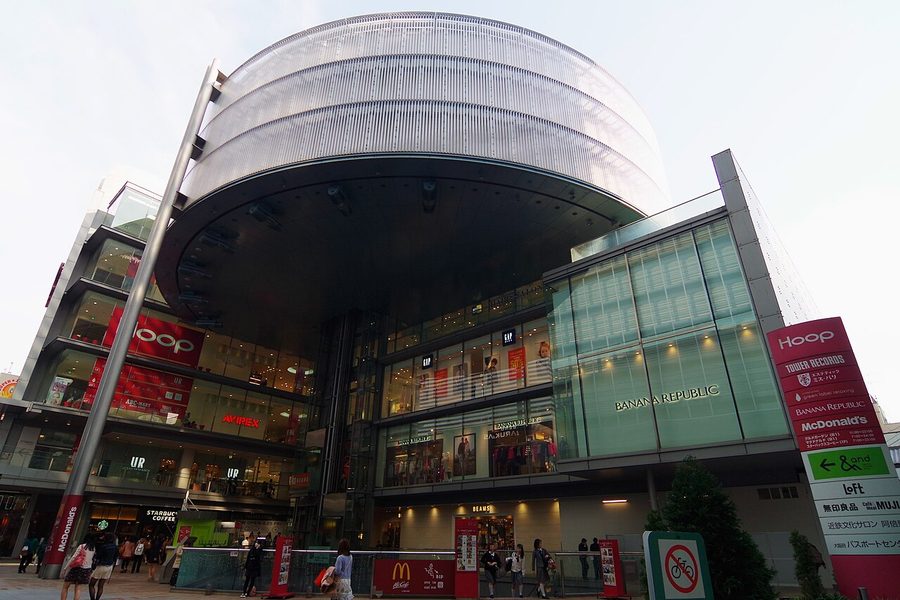
Hoop, the round glass building across Abeno-suji from Harukas, is Kintetsu’s younger, cheaper sibling: shops 11:00–21:00 and restaurants 11:00–23:00. In spring 2026 it gained CAPCOMIX on the third floor, Capcom’s play centre with digital games built around its characters, open 11:00–21:00 from Sunday to Thursday and to 22:45 on Fridays, Saturdays and the day before a holiday. For a family stuck in the rain, it solves an afternoon.
Ura-Tennoji, the bars behind the station
Walk out of the JR station’s north side, away from the towers, and within a minute you are in Ura-Tennoji (裏天王寺), “back Tennoji”, a few lanes of small bars and eateries around the Hanwa shopping street (阪和商店街). It is the opposite of Harukas: standing bars, grilled pork skewers, tiny sushi counters, a few places that pour from the morning, and lanes that fill with office workers after work.
Shops come and go here fast, so I would not chase a name. Pick a counter that is busy but not full, and order what the person next to you is having. Carry cash, because many of these counters take nothing else, and expect the menu to be strips of paper on the wall.
If you asked me where to eat in Tennoji, then: Harukas Dining for a reliable sit-down meal, the Plaza basement and the department store food halls for a picnic, Ura-Tennoji for a drink, and a short trip out for the two things the south side does best, kushikatsu in Shinsekai and yakiniku in Tsuruhashi.
Sweets worth a detour on the Uemachi side
Ask anyone in south Osaka for a cake shop and, until recently, you got one answer: Nakatanitei (なかたに亭), the pâtisserie in Uehommachi famous for its chocolate cakes and for a queue that formed before opening. That answer is out of date. Nakatanitei closed on 17 March 2024 after 37 years, and on its last day about 300 people were in line two hours before the doors opened.
The good news is that its recipes did not vanish. Héritage, a small cake shop opened by a pâtissière who trained at Nakatanitei, sits at 1-6 Rokumantai-cho in Tennoji ward, about 300 metres from Shitennoji-mae Yuhigaoka Station on the Tanimachi Line. Its name means “heritage”, and its petit choux and a cake named after the shop are what people queue for. It was opening Wednesday to Sunday from 11:00, and only Thursday to Sunday in October and November, so check its Instagram before you cross town.

For gelato, the walk is up the plateau to Tanimachi 7-chome. Gelateria Circo d’Oro has been making ice cream in Osaka since 1985 and at this address since 2005; the shop placed fourth in a gelato contest in Italy, which it mentions about as often as you would expect. It opens from 11:00 and closes on Wednesdays and Thursdays, plus breaks it posts on its site (in 2026 it took 14 to 22 October off). Tanimachi 6-chome Station on the Tanimachi Line is the nearest stop.
The old sweet of the district is the tsurigane manju, a small sponge cake filled with red bean paste and shaped like a temple bell, made to mark the great bell Osaka’s merchants gave Shitennoji, finished in 1903. Two firms make it. Sohonke Tsuriganeya has its shop near the temple’s stone torii, and Tsuriganeya Honpo sells from Shinsekai, so buy whichever is on your route.
The temple town and the Seven Slopes
North of Shitennoji, the edge of the Uemachi plateau carries about 200 temples and shrines along Uemachi-suji, said to have been gathered here by Toyotomi Hideyoshi, partly so their walls could double as a defensive line. Osaka calls it the temple town, and most of it is free to walk into.
Between the temples, seven old slopes climb from the flat city onto the ridge: the Tennoji Seven Slopes (天王寺七坂). Shingonzaka, Genshojizaka, Kuchinawazaka, Aizenzaka, Kiyomizuzaka and Tenjinzaka are the ones you will cross on a walk from the temple to Tanimachi 9-chome. Do them on a weekday morning, when the slopes are nearly empty.
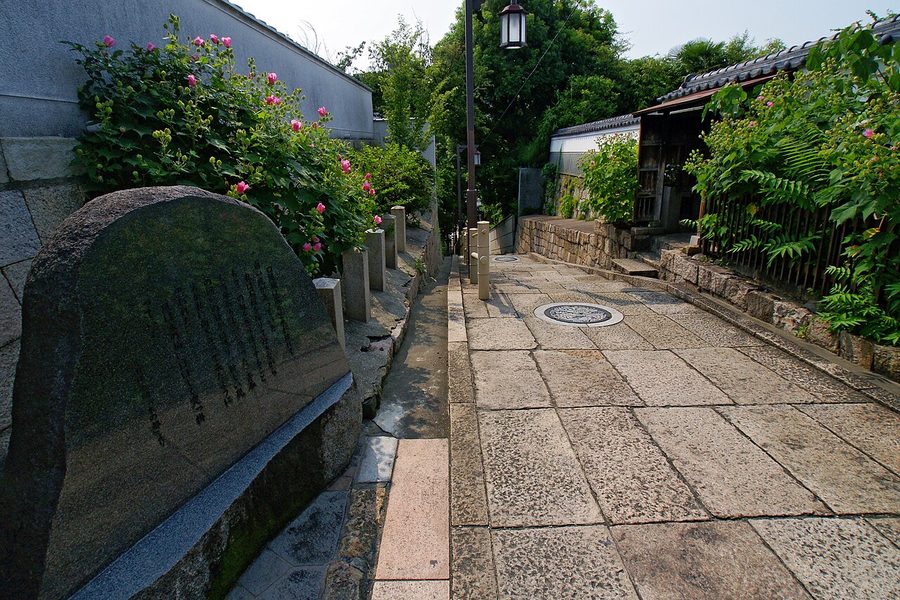
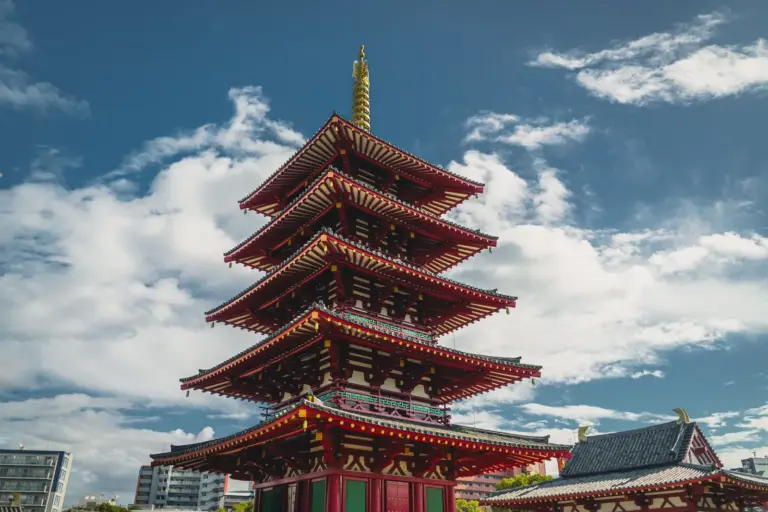
Kuchinawazaka (口縄坂) is the prettiest, cobbles turning into stone steps between temple walls, with a weeping cherry in the garden of Zenryuji in spring. Further south, Aizenzaka leads to Shoman-in, better known as Aizendo (愛染堂勝鬘院). Its main image, Aizen Myoo, has a furious face and a reputation as the god of love, and its pagoda, rebuilt under Hideyoshi in 1597, is one of the oldest wooden buildings in Osaka city.
Isshinji and the bone Buddhas
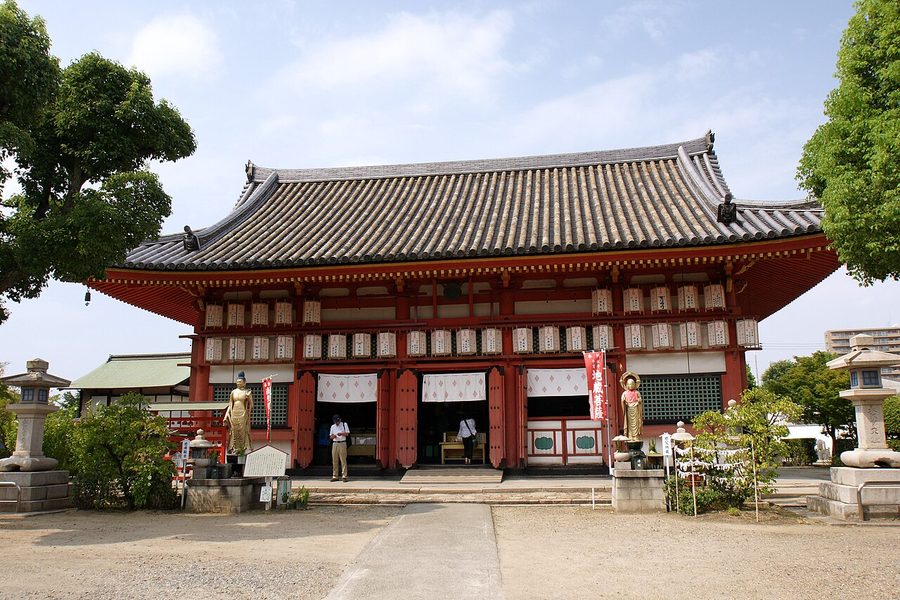
The strangest and most moving temple on the plateau is Isshinji (一心寺), a 15-minute walk from Tennoji Station. It traces itself to 1185, when the monk Honen kept a hermitage here and watched the sun set over a sea that has long since retreated west. It is famous for taking in the ashes of anyone who asks, of any sect or none.
Every ten years the temple mixes the ashes it has received into a statue of Amida Buddha, an okotsubutsu, or bone Buddha. The first was made in 1887, and the six made before the war were destroyed in the air raids, so eight now sit in the hall. The 15th, made from about 240,000 people’s remains received from 2017 to the end of 2026, will be unveiled in June 2027 and shown in the grounds from 2 to 22 June, 5:00–18:00.
Shitennoji
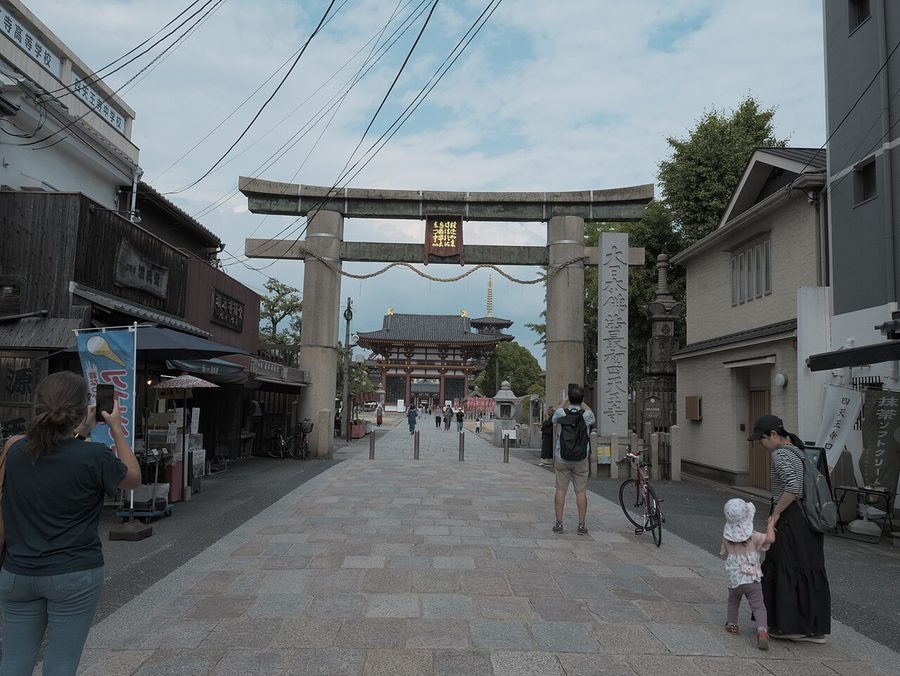
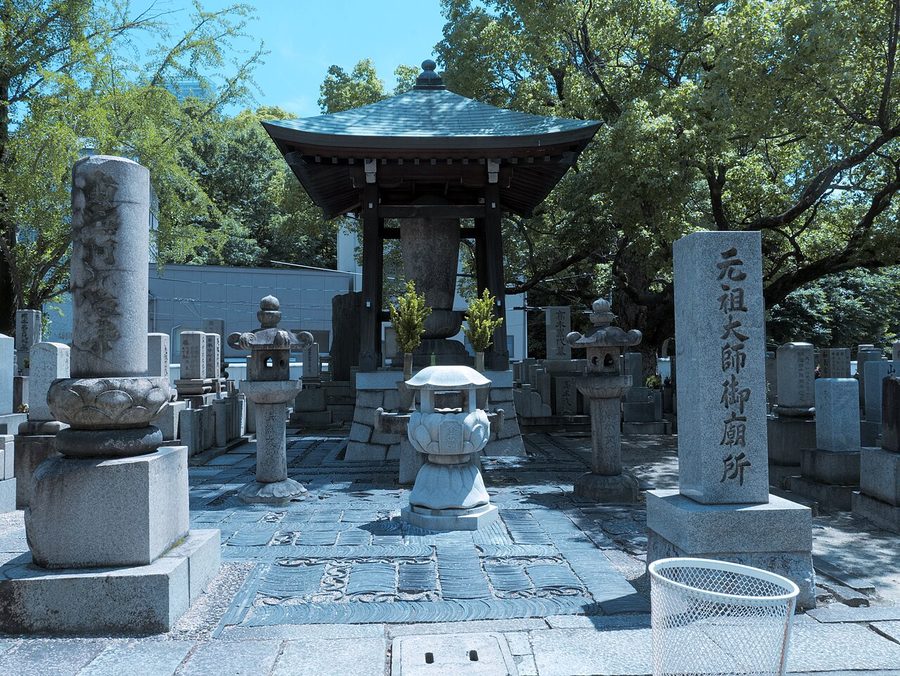
Shitennoji deserves a morning on its own: founded by Prince Shotoku in 593, rebuilt again and again, and still laid out on its original line of gate, pagoda, main hall and lecture hall. Its gates are open around the clock, so you can walk the outer grounds at any hour.
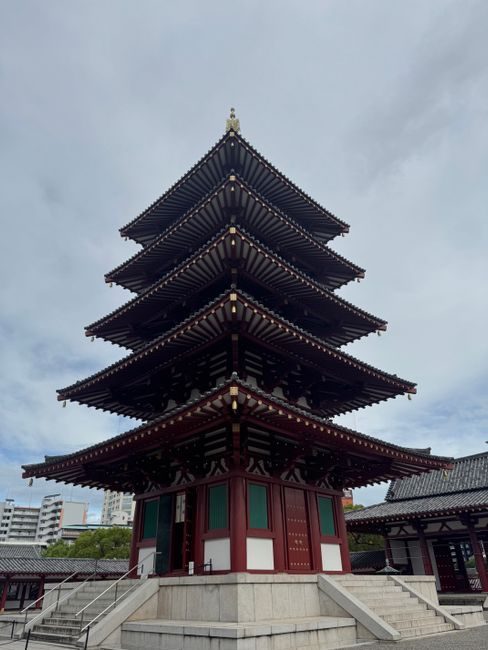
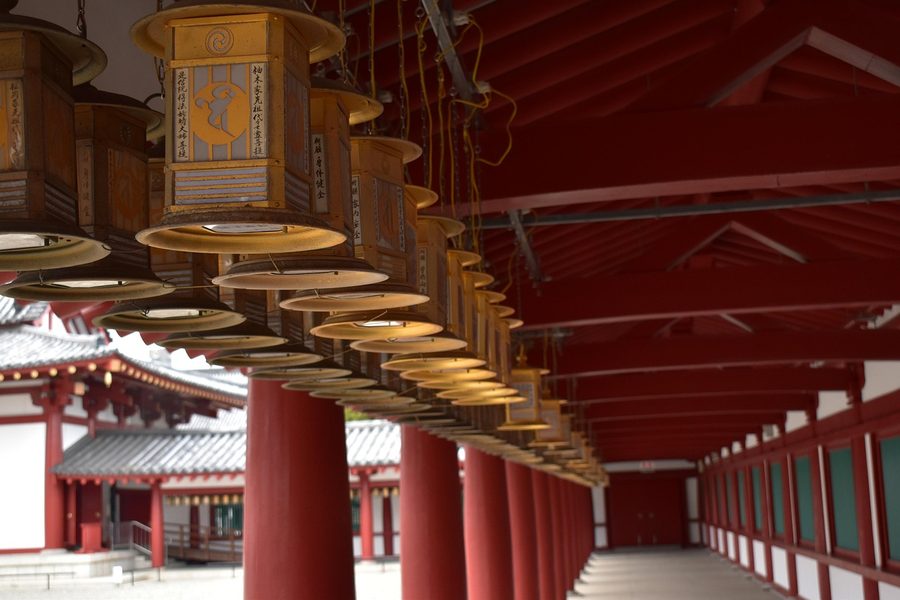
Go on the 21st or 22nd of the month if you can. Those are the temple’s Daishi-e and Taishi-e days, when the central precinct is open free of charge and the grounds fill with stalls selling antiques and second-hand goods. On every other day, the corridor round the central precinct, hung with bronze lanterns, is the quietest place within a kilometre of the station.
The Hankai tram to Sumiyoshi
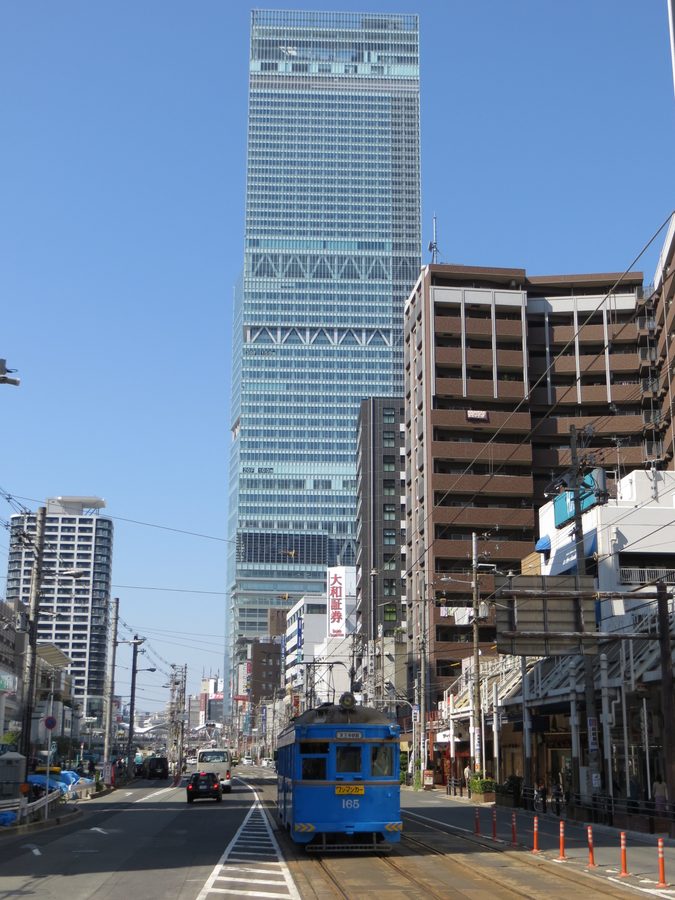
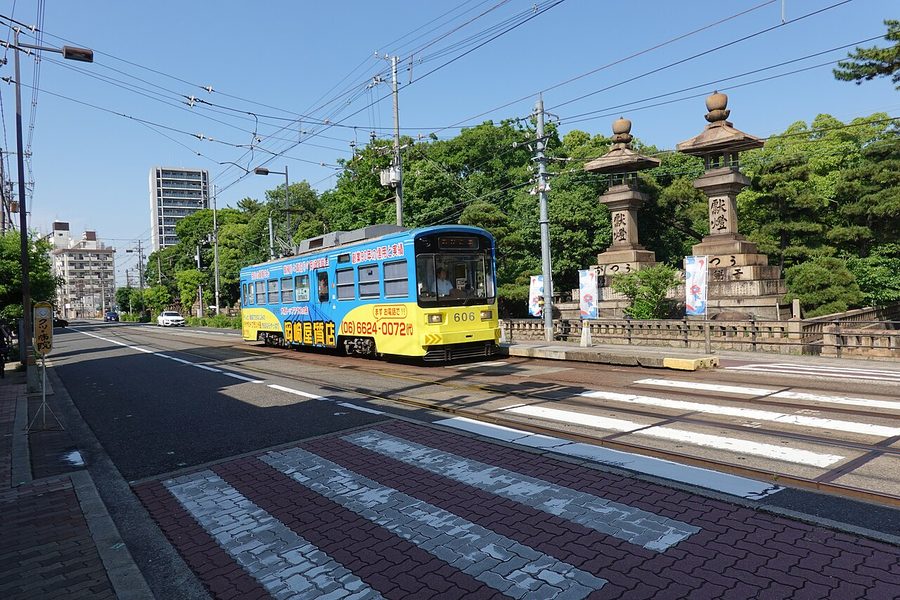
The cheapest sightseeing ride in Osaka leaves from the middle of Abeno-suji. The Hankai Tramway (阪堺電車) is Osaka’s only surviving tram, and its Uemachi Line runs from Tennoji-ekimae, at the foot of Harukas, south through Abeno and Sumiyoshi wards. It began in 1900 as a horse tramway, went electric in 1910, and has reached its present form by a slow series of mergers and handovers ever since.
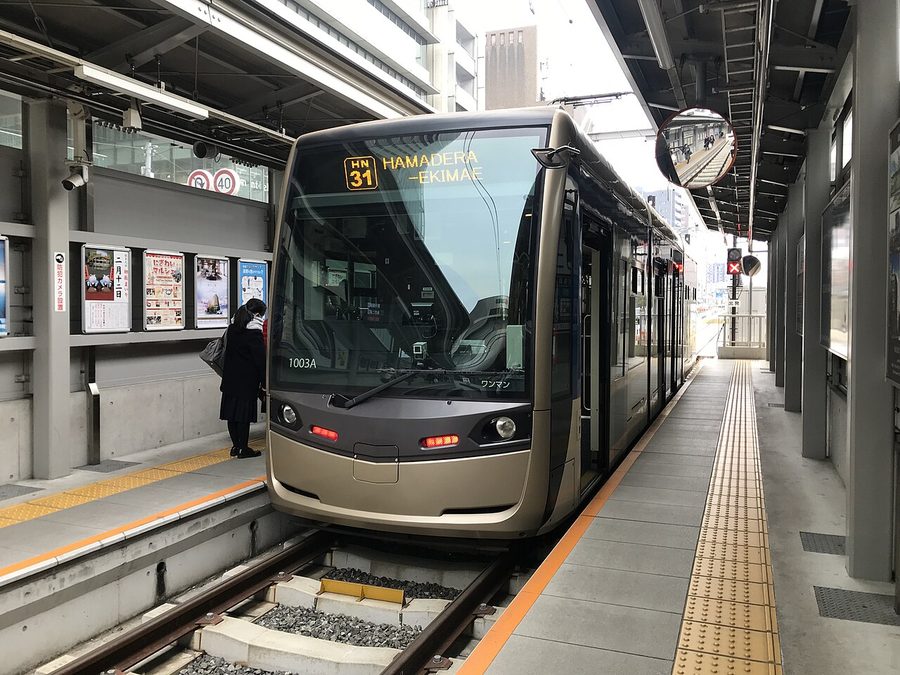
How it works, as of November 2026:
- Fare: one flat fare of ¥240 for adults and ¥120 for children, however far you go.
- Paying: board at the rear door, pay at the front as you leave, with cash or any Japanese transport IC card (ICOCA, Suica, PASMO and the rest). Credit cards, QR codes and other e-money are not accepted. A change machine by the driver takes ¥1,000 notes.
- Day ticket: the Tekuteku Kippu, a scratch-card day pass for the whole network, costs ¥700 for adults and ¥350 for children, sold at Tennoji-ekimae and on board. A digital day ticket on a phone app costs ¥680.
- Changing: if your destination needs a change, pay at the transfer stop (Sumiyoshi or Abikomichi) and take a transfer slip.
Three rides cost more than the day pass, so if you plan to hop off even once on the way, buy the pass. From Tennoji-ekimae the stops run Abeno, Matsumushi, Higashi-Tengachaya, Kitabatake, Himematsu, Tezukayama 3-chome, Tezukayama 4-chome, Kaminoki and Sumiyoshi, where the line joins the Hankai Line; Sumiyoshi-toriimae, for the shrine, is the next stop. The company puts the ride at about 15 minutes.
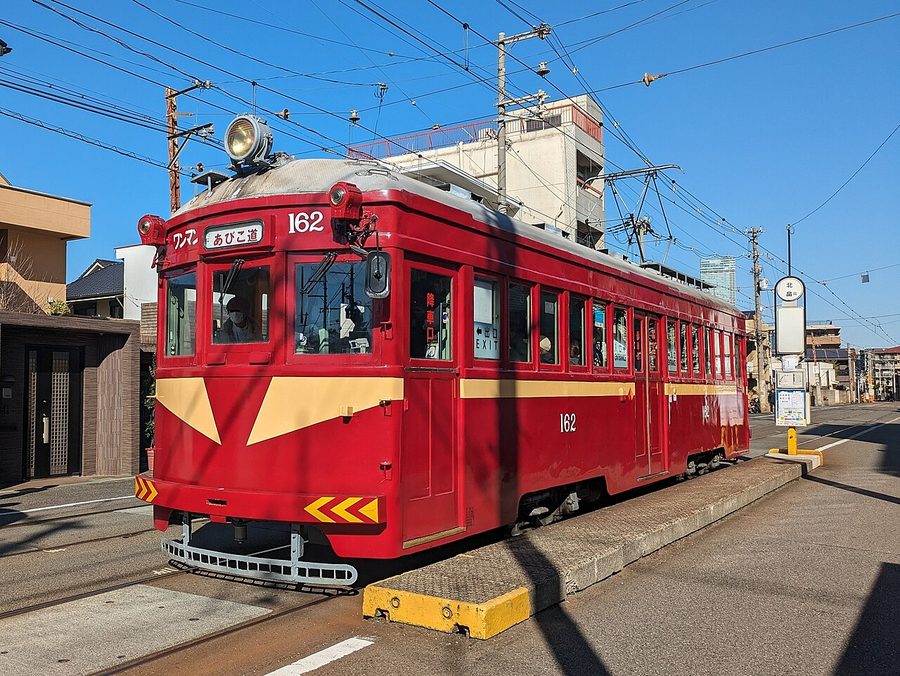
What is along the line
Get off at Higashi-Tengachaya for Abe Oji Shrine (阿倍王子神社), one of the waystations on the old pilgrim road to the Kumano shrines in the mountains of Wakayama, and a reminder that this ground was on a pilgrim highway long before the shops came. A few minutes’ walk away is Abe no Seimei Shrine (安倍晴明神社), which marks the traditional birthplace of Abe no Seimei, the court astrologer and diviner who became Japan’s most famous sorcerer in later legend.
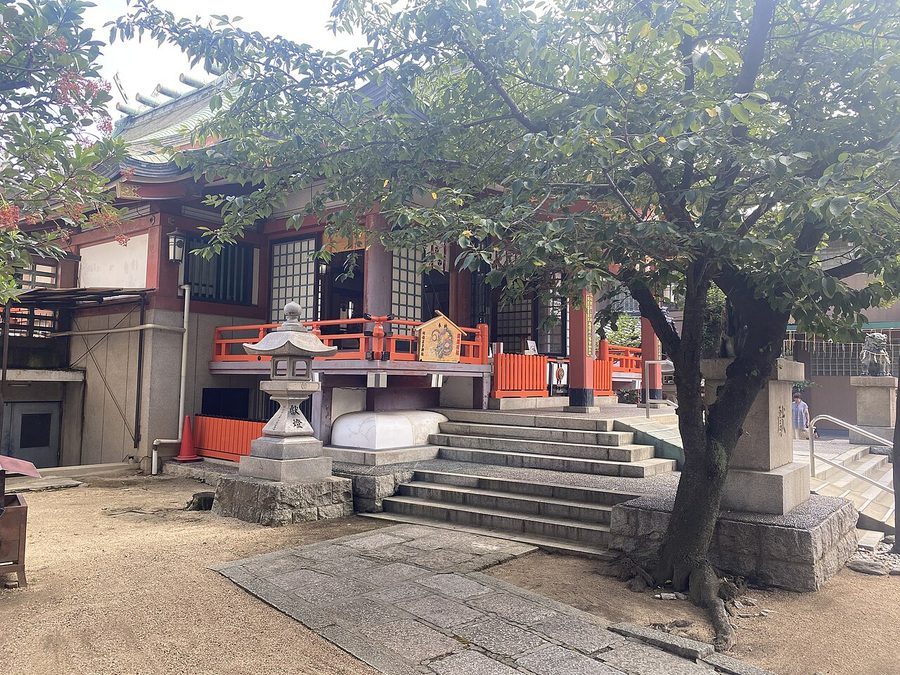
Sumiyoshi Taisha
The tram stops right at the front gate of Sumiyoshi Taisha, the head shrine of about 2,300 Sumiyoshi shrines across Japan and one of the oldest in the country. The shrine counts its history at about 1,800 years. Its four main halls, built in the Sumiyoshi style, one of the oldest forms of shrine architecture, are all National Treasures.
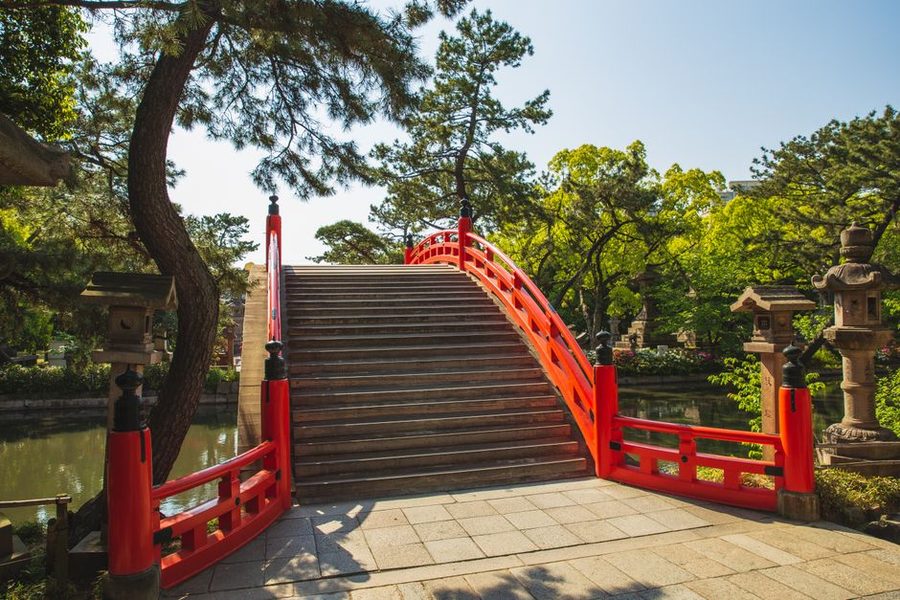
Everyone photographs the Sorihashi (反橋), the steep vermilion bridge over the pond at the entrance, also called the Taikobashi, or drum bridge. It is about 20 metres long and 3.6 metres high, with a slope of up to about 48 degrees at the steepest point. Coming down is where people slip, so hold the rail.
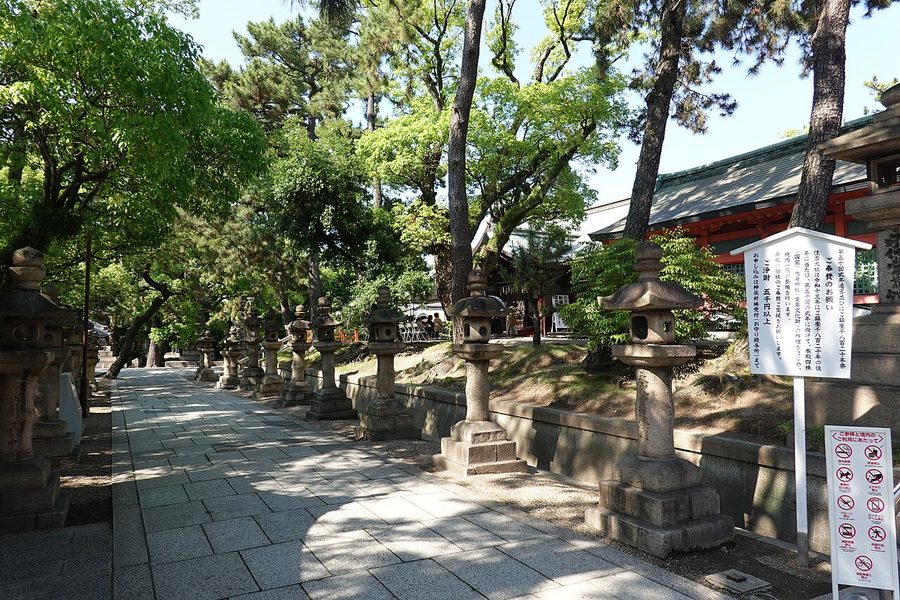
Hours are earlier than you might expect. The gates open at 6:00 from April to September and 6:30 from October to March (6:00 on the first day of each month and on the month’s first day of the dragon), the outer gates close at 16:00 and the inner precinct at 17:00, and entry is free. The amulet counter is open 9:00–17:00. At New Year the crowds are enormous and the roads around the shrine close to traffic.
Two minutes from the shrine, Sumino-e Miso Ikedaya Honpo has sold miso since 1531 from a shop building that is now a registered cultural property; its “eating miso” is meant to go straight on rice. From Sumiyoshi-toriimae you can carry on south on the same day ticket to Sakai, about 15 minutes further, for its knife shops and Sakai Riso no Mori, the museum of the tea master Sen no Rikyu and the poet Yosano Akiko.
Tsuruhashi, to the north-east
Three stops round the JR Osaka Loop Line from Tennoji (Teradacho, Momodani, then Tsuruhashi), you step off the train into the smell of grilling meat. Tsuruhashi is Osaka’s yakiniku district. It is also where you can see the city’s Korean community in its own streets.
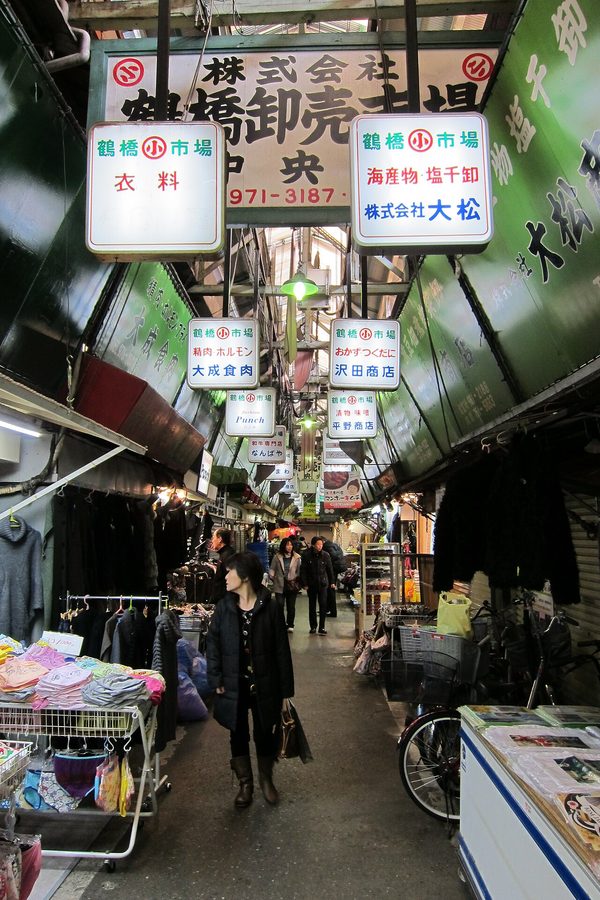
The market around the station grew out of a black market that gathered about 3,000 street sellers after the war. Today six markets and shopping streets hold about 800 shops across three wards, an area about the size of two baseball stadiums. Go in hungry. Besides the yakiniku restaurants, stalls sell tteokbokki (rice cakes in sweet chilli sauce) and kimbap to eat on the move, which is the answer to the question of where to snack your way around the south side.
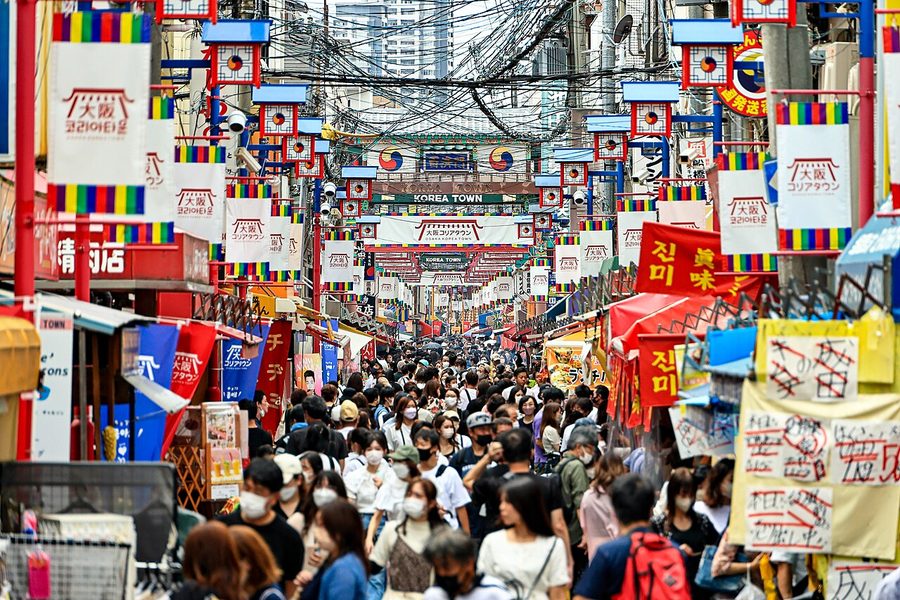
About ten minutes’ walk from Tsuruhashi or Momodani Station is Osaka Korea Town, a long shopping street that has turned from an old neighbourhood arcade into a weekend magnet for young people after Korean food and goods. Arrive on a weekday if you want to walk rather than shuffle.
Shinsekai, the park and Spa World
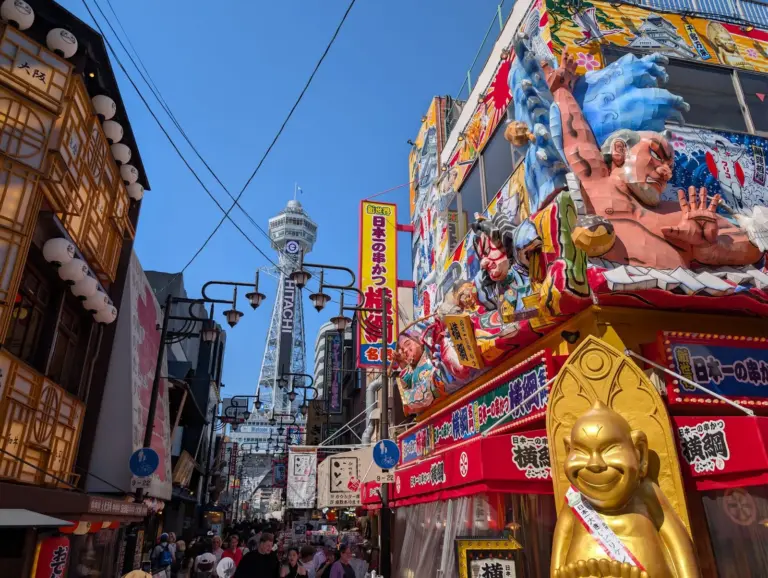
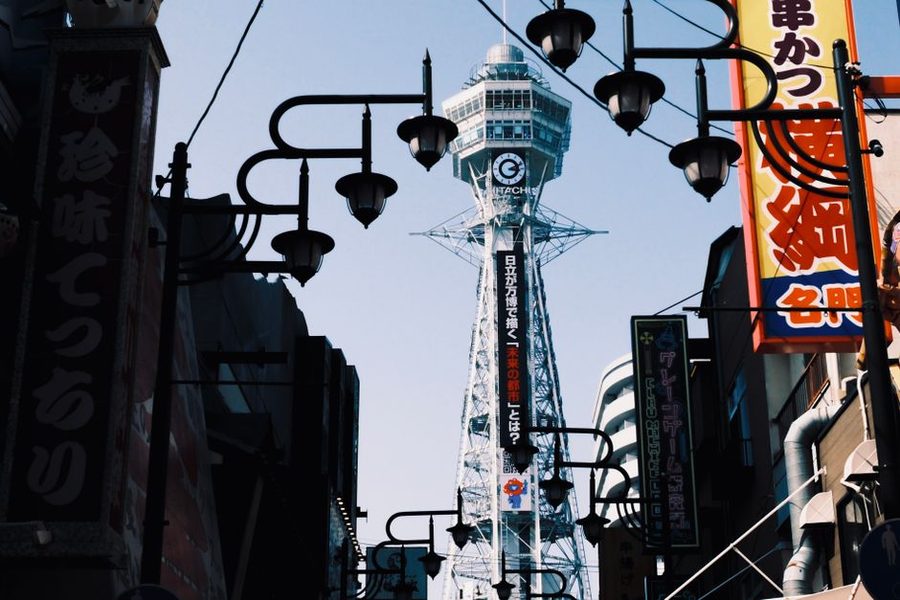
Shinsekai is the 1912 pleasure district a stop west on the Midosuji Line at Dobutsuen-mae, or a walk across the park. Its covered alley, Janjan Yokocho, is the place for kushikatsu, and the rule there is one dip in the shared sauce. Tsutenkaku Tower stands at its centre, a 1956 steel tower with Billiken, the god of things as they ought to be, waiting at the top; it is lower than Harukas by about 200 metres and much better at being photographed.
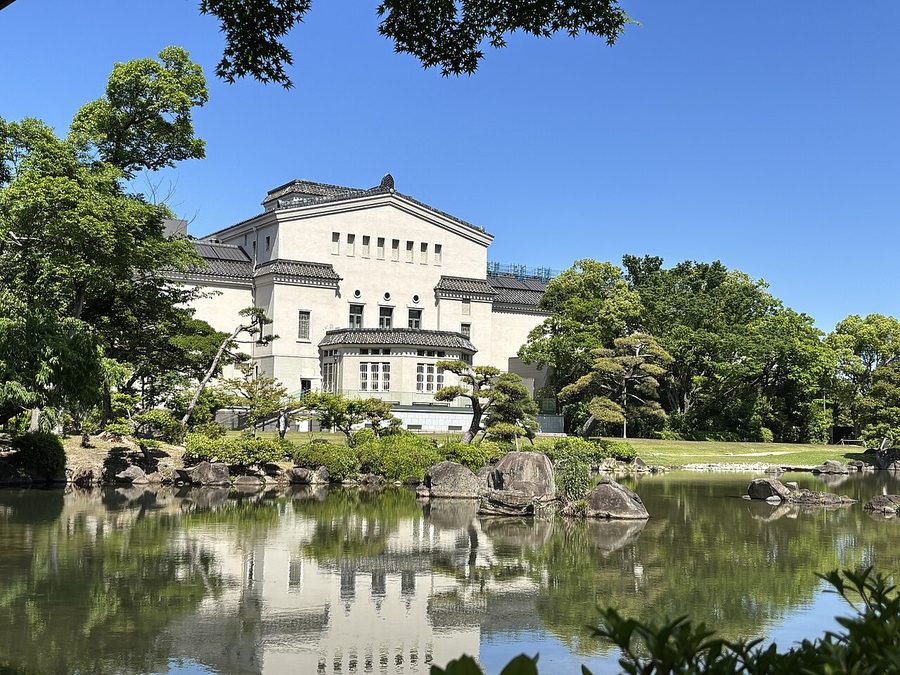
Tennoji Park, between the station and Shinsekai, holds the zoo, the Tenshiba lawns at the station end, the Keitakuen garden and the Osaka City Museum of Fine Arts, which is showing Ming-dynasty calligraphy until 20 December 2026. Like Shinsekai, the park grew out of the 1903 trade fair held on this ground.
Spa World, on the far side of Shinsekai, is the evening plan: themed hot-spring baths over two floors, a flat ¥1,500 bath ticket and no tattoos allowed. It is about 15 minutes’ walk from Osaka-Abenobashi, or one stop on the Midosuji Line to Dobutsuen-mae.
And Namba, the centre of Minami, is three stops north on the Midosuji Line, close enough that many people stay in Tennoji and eat in Namba. For the rest of the city, see things to do in Osaka.
A day on the south side
If you have one day, here is the order I would use. Start at Shitennoji at 9:00 while it is calm, and walk the temple town and its slopes north to Kuchinawazaka. Come back down to the station for lunch in the basement food halls, then ride the tram to Sumiyoshi Taisha and back, which takes about two hours with time at the shrine.
Be on the 60th floor of Harukas an hour before sunset, and walk down to the open deck on 58 as the lights come on. Then cross the park to Shinsekai for kushikatsu, and finish in the bath at Spa World or with a beer in Ura-Tennoji, depending on how much energy you have left.
With half a day, do Harukas at dusk and eat in Shinsekai. With two, give the second morning to Tsuruhashi, a different city three stops away.
Go back to the footbridge, then, at six in the evening. You now know the tower was built to sit on Kintetsu’s tracks, that the slow tram under it will take you to a 1,800-year-old shrine for ¥240, and that the quiet lanes behind the JR station are where the people walking past you are going for a drink. Take the lift up first. Then come down, cross under the deck, and follow them.